
Home
About Us
Products
Process Models
SE Resources
Commentary
Contact us
|
|
|
| Breaking News!
A new blog ... visit OnCenter, Roger Pressman's running commentary on the world at large
A new edition ... the 7th edition of Software Engineering is available now
A new book ... Roger Pressman and David Lowe on Web Engineering
A first novel ... Roger Pressman's first novel is a technothriller -- The Aymara Bridge
A new curriculum! RSP&A has partnered with QAI to develop a comprehensive Internet-based software engineering curriculum.
A redesigned site! We've done a major redesign and added many new features for 2009 - 2010
|
|
|
|
|
|
|
|
|
|
Software Engineering Resources
Prescriptive Software Process Models |
|
|
|
|
|
|
|
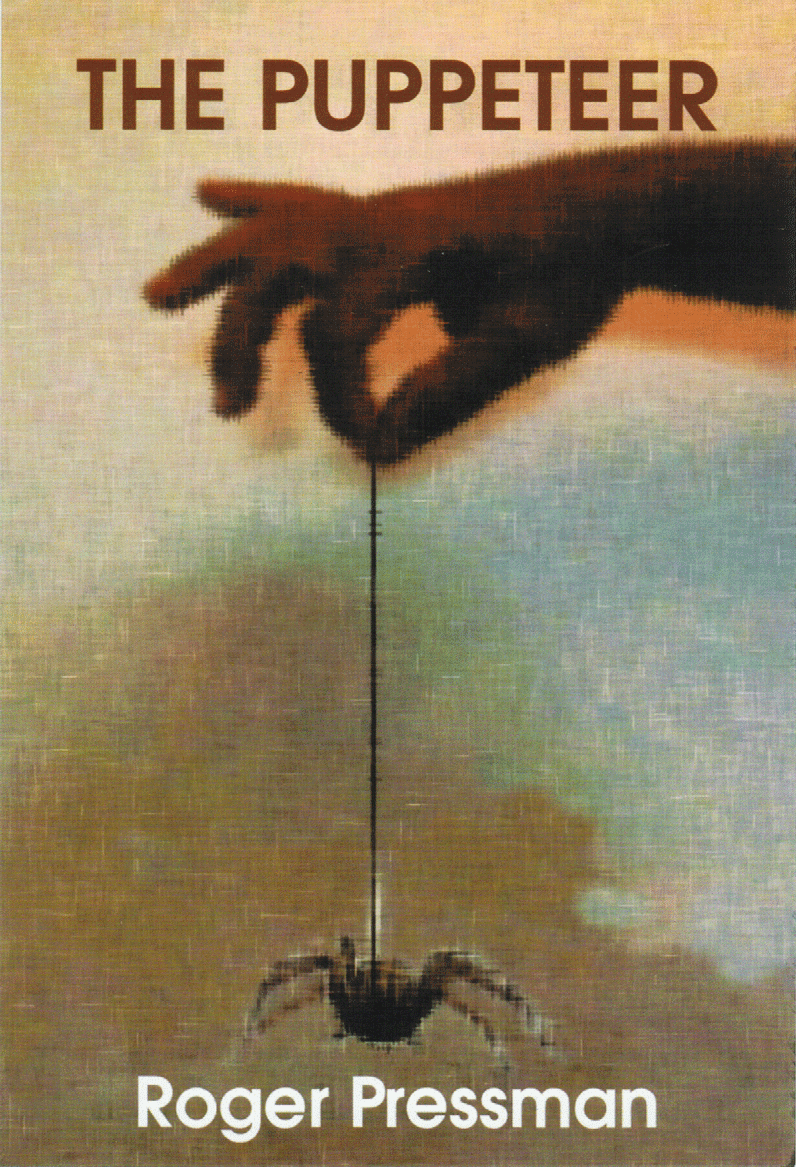
Another novel by
Roger Pressman! |
|
|
 |
|
|
| Available in trade paperback and e-book editions. For more information, click here. |
|
Process Models and Modeling
Process Patterns
Agile Process Models
Aspect-Oriented Modeling and Programming
• Resources
Component-Based Software Engineering
(see also our Component-Level Design page)
Formal Methods
(see also our Formal Methods page)
Formal Methods
RSP&A has developed a separate page for Formal Methods resources.
Incremental Development
Iterative Software Development-Hotlist
Useful pointers for both iterative and incremental development.
Prototyping
Prototyping Tutorial
Another in-depth tutorial (slide presentation) on prototyping
Prototyping Notes
A abbreviate set of lecture notes on prototyping.
Prototyping Bibliography
An extensive prototyping bibliography prepared by the SEI.
Software prototyping
An indepth introduction at Wikipedia.
ppt: Software Prototyping
A Powerpoint presentation covering many important aspects of the subject.
Top ten tips for software prototyping
The top ten tips to help you rapidly prototype software.
What is software prototyping?
An introductory discussion.
Software prototyping
A reasonably detailed discussion of the subject.
Software Prototyping using Scripting Languages
A brief article describing the use of scripting languages (e.g., Perl, Python, PHP and Tcl ) for prototyping.
Rapid Software Prototyping
An introductory discussion.
Rapid prototyping
A 12 step approach.
Software Prototyping Stages
Discusses the three stages of prototyping activity.
Emergent Design vs. Early Prototyping
Emergent design (sometimes referred to as emergent architecture) is an evolutionary prototyping technique used to "evolve" a design, through refactoring, from code-with little or no significant up-front design. This article discusses the concept.
Independent Rapid Prototyping Software Providers
Links to tools vendors who specialize in prototyping tools.
Prototyping and JAD
With prototyping, your team works with the client to collect their requirements, normally done during JAD (Joint Application Development) sessions. As requirements are collected, your technical team should develop prototypes of the screens, reports, processes and the associated workflow.
Software Prototyping Technology
A brief list of papers and links.
The Perils of Prototyping
A dated but still worthwhile discussion of prototyping's dark side.
Paper Prototypes Work as Well as Software Prototypes
An argument in favor of paper prototypes.
PSP/TSP
RAD
Rational Unified Process
The Rational Unified Process
A collection of white-papers written by staff and consultants at Rational on the RUP
IBM Rational Unified Process
In depth discussion presented at Wikipedia.
Video: Benefits of the RUP Software Development Model
A very brief discussion of benefits.
Rational Process Library
"Rational Process Library offers the industry's most robust collection of best practices guidance for software and systems development, management, and governance." Recommended.
A Manager's Introduction to RUP
A useful overview by Scott Ambler.
Agile Modeling and the Rational Unified Process (RUP)
An argument in favor of combining agility principles, agile modeling, and RUP.
The Rational Objectory Process - A UML-based Software Engineering Process
This paper presents "an overview of the Rational Objectory Process. The Rational Objectory Process is a full lifecycle software engineering process bringing Unified Modeling Language (UML) best practices to the fingertips of each software developer. Objectory is a controlled iterative process, with strong focus on architecture. It is a use-case driven, object-oriented process, using the UML as a notation for its models. Objectory can be configured to fit a wide range of projects."
Rational Unified Process for Systems Engineering
"This paper introduces a variant of the Rational Unified Process (RUP) that addresses the problem of system specification, analysis, design, and development. As a derivative of RUP, RUP SE consists of new artifacts as well as modifications of RUP the creation of those artifacts."
Spiral Model
Waterfall Model
The Waterfall Model (Linear Sequential Model)
A quick summary of the waterfall model.
The waterfall model
An in-depth discussion presented at Wikipedia.
Water Fall
A discussion of the waterfall with a number of pointers to commentary and discussion. Recommended.
The waterfall model
A brief overview with discussion of advantages and disadvantages.
The Waterfall Model
A brief discussion and diagram.
The Waterfall Model Explained
A capsule discussion.
Understanding the pros and cons of the Waterfall Model
"This article provides a quick and dirty introduction to the model, explaining what it is, how it's supposed to work, describing the six phases, and why the model can fail."
Six Wise Blind Elephants and The Waterfall Model
Commentary. An allegory.
Waterfall development model considered harmful
Commentary and criticism.
V-Model
|
|
|
|
|
|
|
|
|
|
|
|
|
|
|
We've added links to a search engine that will enable you to search our entire site for information you need. Enter the appropriate word or phrase below.
|
|
|
|
|
|
|
Home About us Products Product Models SE Resources Commentary Contact us
Web site and all contents © R.S. Pressman & Associates, Inc. 2001 - 2010, All rights reserved.
Free website templates
|
|




 discusses modeling techniques that allow the interrelated technical and social elements of the software process to be analyzed.
  and
and